
Getting Clinton County Court Records
Identify the court before anything else. The party name alone will not get you there. The Clerk of Courts CaseLook entry covers Common Pleas civil, felony-criminal, domestic-relations, lien, miscellaneous, and appellate matters. For traffic, misdemeanor criminal, Municipal civil, and small-claims cases, use the Municipal Court Record Search instead. Probate and Juvenile cases run through their own counters. Remember that a search result is only a locator. It is not the clerk's certified record.
You can also inspect or request Clinton County court records straight from the office that owns the case. There is no single universal mail, email, fax, or drop-box request form, and no fixed turnaround. Call the right clerk first. The office can confirm availability, current charges, delivery method, and whether direct access fits your request, before you send any payment.
- Write down the court, case number if known, case type, document name, and the date or docket event that identifies the item.
- Use CaseLook or Municipal Record Search to confirm which Clinton County court owns the case and to locate the relevant docket entry.
- Choose an inspection, a plain copy, an authenticated or certified copy, or a transcript. Those are different record products.
- Contact the Clerk of Courts, Municipal Court Clerk, Probate Court, or Juvenile Court counter that keeps that category of record.
- Confirm the current fee, payment method, format, and access limits before submitting a request or traveling to the counter.
Note: A portal can locate a filing. The clerk's office alone decides whether and how a copy gets inspected, supplied, or certified.
Clinton County Record Custodians
Clinton County's record system is split on purpose. The Clerk of Courts files, dockets, indexes, and preserves Common Pleas civil, felony-criminal, domestic-relations, and Twelfth District appellate records. The Municipal Court Clerk keeps its own countywide set. Its files cover traffic, misdemeanor, civil, and small-claims cases. Probate and Juvenile each run separate clerk functions as well. Route your request to the office that owns the case. Not every courthouse record is a Clerk of Courts record.
| Record category | Custodian and first route | Useful distinction |
|---|---|---|
| Common Pleas civil, felony, domestic relations, appeal | Clerk of Courts and CaseLook | The Clerk maintains these files and issues its own copies. |
| Traffic, misdemeanor, Municipal civil, small claims | Municipal Court Clerk and Record Search | This is a separate court system and separate fee schedule. |
| Probate and Juvenile | Respective court counter | Public-search and access limits differ, especially for Juvenile records. |
The official county courts directory lays out each separate court component. Check it first when a case notice names Probate or Juvenile instead of Common Pleas or Municipal Court.
Clinton County Court Record Types
Think of a docket as the case's chronological locator. The documents behind those lines can include pleadings, orders, judgments, attachments, or a transcript request path. What you should ask for depends on the item. A certified copy is authenticated by the clerk. A portal view or plain photocopy is not.
- Docket or Record Search result: a chronology and basic case-event locator.
- Filed document: a pleading, order, judgment, or attachment in the court file.
- Certified or authenticated copy: a copy with the custodian clerk's authentication.
- Transcript: a record of proceedings obtained through the court's reporter or transcript process.
- Appeal record: a separate appellate docket and file when review reaches the Twelfth District.
The filing cover available through the Clerk is for filings only. It is not a general record-request form. Likewise, mandatory electronic filing for designated Common Pleas case types does not make the Henschen portal a public document-copy service.
Clinton County Search Is Not Certification
CaseLook says so itself. Its warning states that displayed computer information can lag a filing or court action by at least 24 hours. Sometimes the delay runs longer. For verified information, it points users to a request to the Clerk. A visit during regular hours works too. The Municipal Court interface works as a locator and calendar tool. It shows public case and setting information. But not every order, attachment, financial entry, or document image is available remotely.
The boundary is practical. Use a docket entry to spot the date and description of an order. Then ask the custodian for the order itself when exact wording matters. Judgments, exhibits, and older files call for the same approach. And a no-image result proves nothing. It does not mean the document never existed or that it is sealed.
Note: Confirm the current file and certification process with the clerk. Do that before relying on a screen display for any official purpose.
Inside a Clinton County Court Record
What shows up in a Clinton County court record depends on the case type and the access rules. The Municipal Daily Docket lists an event date, setting time, judge display, description, case type, case identifier, and a Docket Entries link. CaseLook sorts Common Pleas cases into categories including CA, CV, CR, DR, JL, and MI. The docket points to activity. It does not promise a full remote file.
| Case number | The court-assigned identifier. Local forms may require only the numeric portion; use no real case number in a general request. |
|---|---|
| Docket sheet | Chronological filed and court-action entries, including settings and event descriptions. |
| Pleadings and motions | Documents filed in the case, subject to remote-access and restriction rules. |
| Orders and judgments | Court directions or determinations; obtain the actual order for verified wording. |
| Exhibits and attachments | May be treated differently from a remotely visible docket under Ohio access rules. |
| Transcript | A proceedings record obtained by the court's transcript process, not merely a docket printout. |
The Twelfth District jurisdiction roster shows that a Clinton County appeal travels its own appellate record path. An appellate docket is not simply one more entry in the trial-court search.
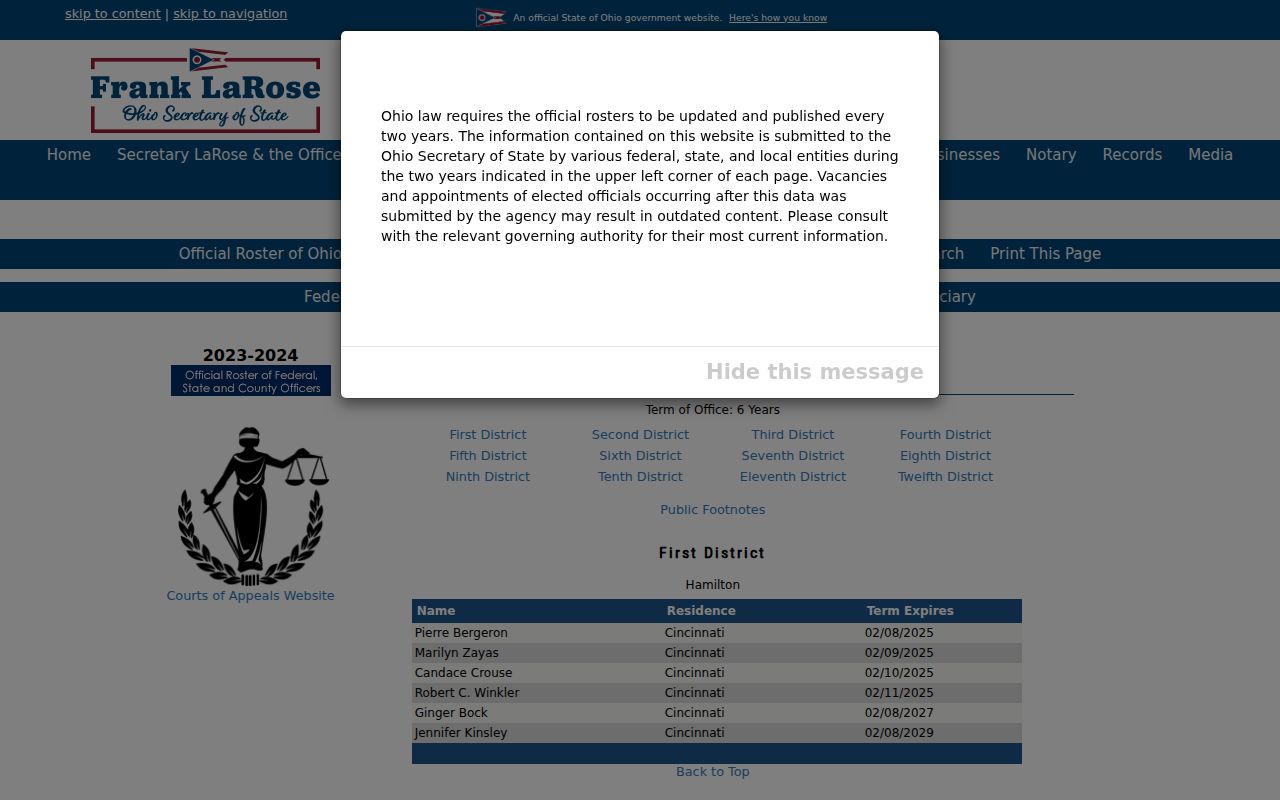
That roster backs up the split between a trial-court file and a later appellate record.
Clinton County Personal Identifier Limits
Ohio's court-access rules do not put every part of a case file online. Parties must leave protected personal identifiers out of publicly accessible documents. Courts can restrict access under the Rules of Superintendence. The Clerk's forms page includes a Personal Identifier form. That form is a local sign that sensitive information gets separate handling. Do not add personal identifiers to a request just because a portal wants a case locator.
The Juvenile Court shows how this works. Its cases do not become ordinary public search results. A similar adult case might appear on a docket. Restriction, sealing, and statutory access rules all require asking the court that holds the record. The Clinton County Juvenile Court page identifies that separate channel.
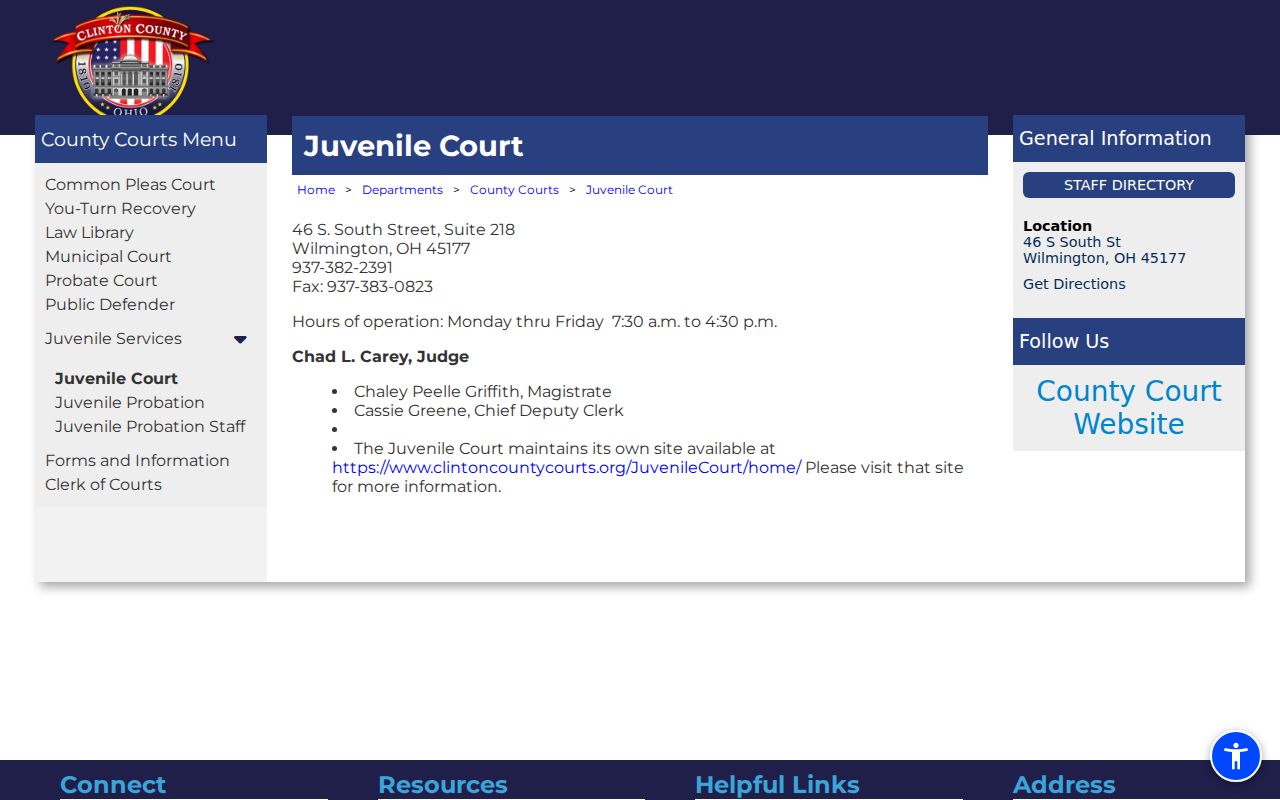
Juvenile records need the Juvenile Court's own access route. No general portal assumption substitutes for it.
Clinton County Fees and Certified Copies
Each Clinton County court sets its own copy fees. The numbers depend on which office holds the record. At the Clerk of Courts, a plain copy runs 10 cents. A certified copy there costs the page price plus $2 per document. Municipal Court prices its copies differently. It charges $1 per page for the first five pages, 25 cents for each additional page, and $10 for an authenticated copy. Confirm the current amounts with the office before you pay. The Clerk's fee schedule still carries an older effective-date heading. That is one more reason to check.
| Custodian service | Published amount |
|---|---|
| Clerk of Courts plain copy | $0.10 per page |
| Clerk of Courts certified copy | $0.10 per page plus $2 per document |
| Municipal Court copies, first five pages | $1 per page |
| Municipal Court additional pages | $0.25 per page |
| Municipal Court authenticated copy | $10 |
The Clerk fee schedule and the Municipal Court fee schedule are the official price lists. Each belongs to a different office, so they do not substitute for each other.
Clinton County Clerk of Courts Legal Office
46 S. South Street, Suite 333
Wilmington, OH 45177
937-382-2316
Note: Before sending payment, ask the court that owns the record about current fees, whether the document is available, and whether its official label is certified or authenticated.
Clinton County Records and E-Filing
Electronic filing and public record access are two separate things in Clinton County. The Clerk's 2024 mandatory e-filing notice governs how certain Common Pleas filings get submitted. Local Civil and Criminal Rule 8 governs them too, through Henschen eFiling. Finding those records is another matter. The public still turns to CaseLook for Common Pleas records. Some users get direct access straight from the Clerk.
That gap shows up when a filing seems hard to reach. No universal online price exists for document images. There is also no general online form for certified copies. Once CaseLook surfaces a filing or a docket date, a direct inquiry with the clerk is the sensible next move.
For the rules behind Ohio public-office records, R.C. 149.43 lays out what offices must make available.
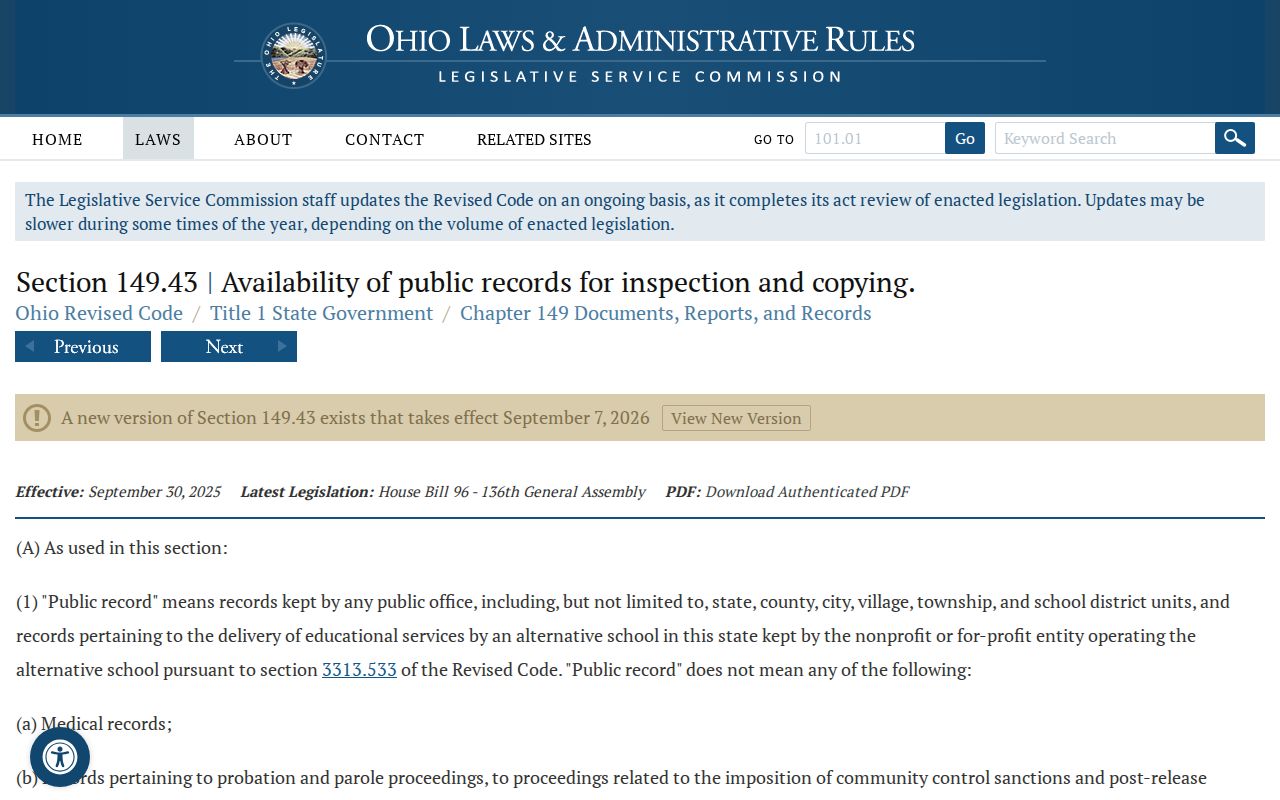
Court case records themselves fall under the Ohio Rules of Superintendence, a more specific access framework.
Clinton County Court File Follow-Up
A Clinton County court record may not show online. Write down the locator details before you call. The clerk will ask for them. The court name helps. So do the case number or party name, the case type, and the document title. The docket date matters too. Together they narrow the request. You should not have to hand over personal information you do not need to share. Ask as well whether the item can be inspected, copied, or certified on the spot. A separate transcript or access procedure may apply instead. The Clerk's own CaseLook warning makes direct follow-up vital for new Common Pleas activity. On the Municipal side, the Record Search and Daily Docket can show a current setting. Copies come from the Municipal Clerk alone. No single office publishes one universal image price, mailed-record form, or turnaround time for every Clinton County court. The office that owns the record is where those current answers live.
Sealed Records and Clinton County Access
Ohio Rules of Superintendence 44 through 47 presume that court records are open. They allow direct access at reasonable times. Remote access, though, does not have to cover every document or exhibit. The rules also permit restriction procedures. They can shield personal identifiers. Under R.C. 2303.901, case documents include dockets. Identifiers and certain protected material stay out of public view. For non-case administrative records, the Ohio Public Records Act does most of the work.
Ohio access rules.
Ohio Sup.R. 44–47 set the principal access, redaction, and restriction rules for court case records.
R.C. 2303.901 recognizes dockets as case documents while protecting identifiers and restricted material.
R.C. 2151.356 provides a juvenile-record sealing framework, which helps explain why a Juvenile file may not be publicly searchable.
A source image of Ohio's juvenile-record sealing statute illustrates the separate legal boundary.
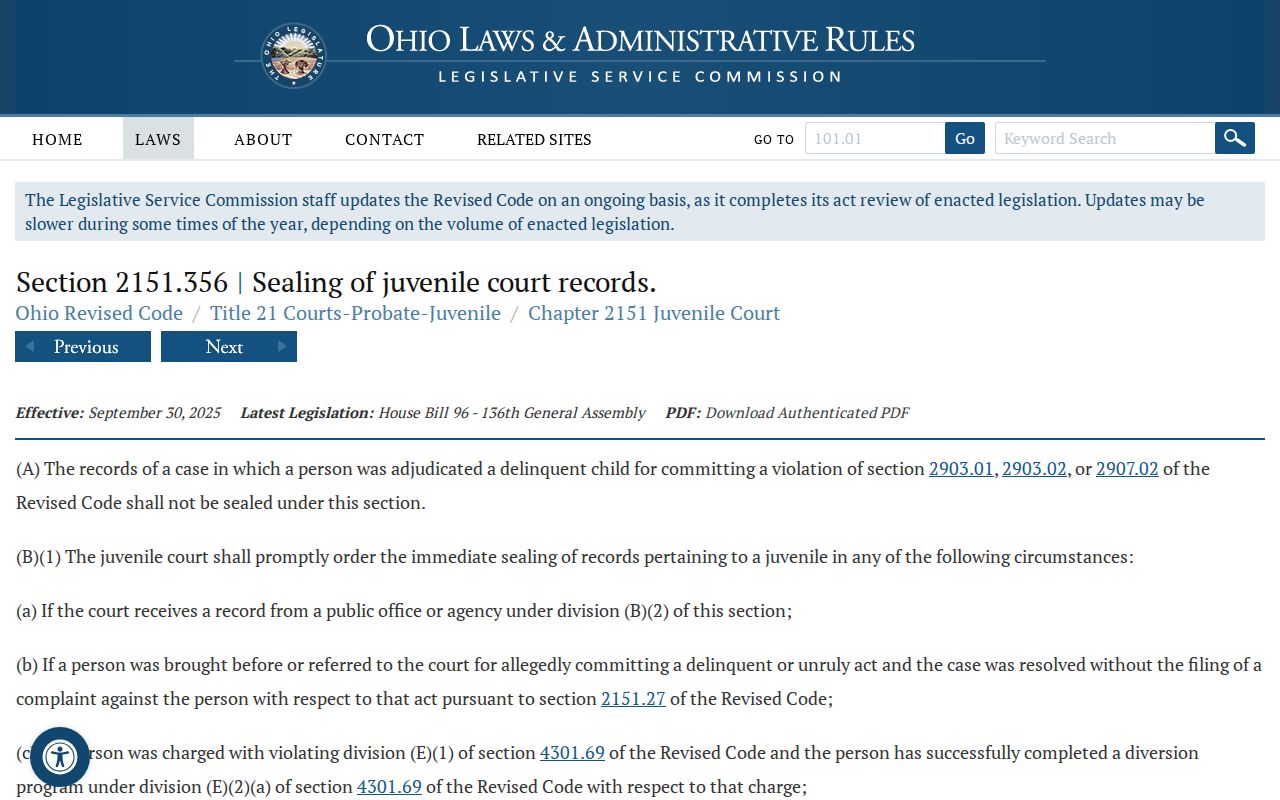
A restricted result calls for one simple move. Ask the owning court about its access procedure. A missing portal entry, on its own, answers nothing.